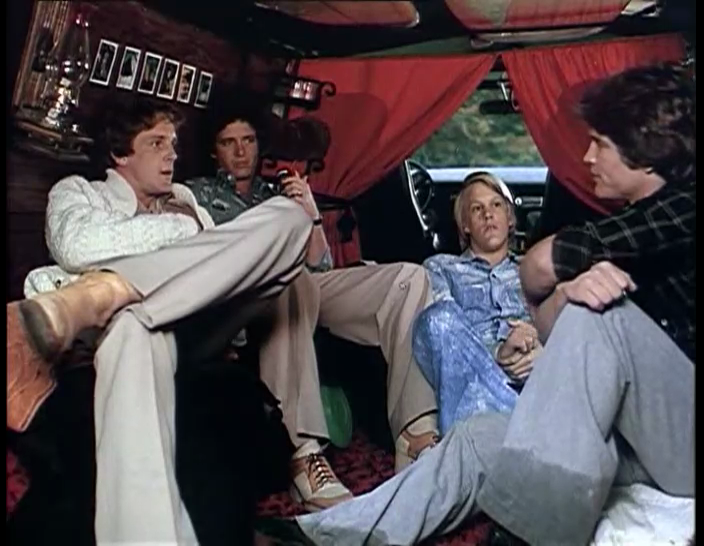
“Perverts and sluts...
They’re doing everything they can to take him away from us...”
At age 3, Billy Lynch (Jimmy
McNichol, former teen idol and brother of Kristy) is left to the care of Aunt
Cheryl (Susan Tyrell, in one of the most over-the-top, scenery-chomping roles
of her extensive career) after his parents are killed in a horrific car wreck.
Under Cheryl’s tutelage for more than fifteen years, it’s time for young Billy
to start making plans for college.
But Aunt Cheryl isn’t ready
to let Billy go.
When a brutal murder follows
an “attempted rape,” Billy finds Aunt Cheryl covered in blood, the lifeless
body of a television repairman sprawled on the kitchen floor. As Detective Joe
Carlson (Bo Svenson) begins to peel away the crime’s many layers, he discovers
that Cheryl’s alleged assailant was actually a homosexual, betrothed to Billy’s
basketball coach, with whom Billy shared a close friendship.
As Detective Carlson
continues his investigation, Billy, wrapped up in a nightmare whirlwind he
never could’ve foreseen, begins to do some investigating of his own. In the
process, he comes to find that Aunt Cheryl has a mountain of buried secrets and
will do anything not only to keep them hidden, but also to keep Billy close by.
Butcher, Baker, Nightmare
Maker, also released as Night
Warning, is an odd little gem that explores some very uncomfortable
subjects, including rape, implied incest, and...pickling. That’s right, I said
pickling—and no, that isn’t a euphemism.
Rubber-faced Susan Tyrell
was a woman of many strange expressions, a number of which are present during
the final moments of the film. With a wide-eyed glare and an animalistic snarl,
she quickly sheds the skin of a happy homemaker and transform into an
uncontrollable monster—and man, is it a hoot and a half to witness.
For this commentary, I
discuss my frustrations with Code Red for taking approximately four years to
finally release the DVD they’d promised (Tyrell actually passed away by the
time the disc was available), some behind-the-scenes dirt on the making of the
supplemental materials, and some interesting comparisons between the screenplay
and the novelization.
Note: During the opening
episode’s opening, I reflect upon a comedy sketch involving a car-driving cat
who always ends up careening its passengers over cliffs. What I neglected to
mention was that this was actually a recurring Saturday Night Live sketch
from the early ‘90s, so I wanted to include a little notation here to avoid any
confusion.
Happy
October, B-movie fanatics! Leaves are changing, the smell of pumpkin spice
hangs strong in the crisp autumn breeze, and Halloween is just over four weeks
away! I couldn’t think of a better movie to kick start the celebration of the
season than Kevin Tenney’s original cult classic Night of the Demons!
Demons is one of those rare horror essentials without need
of an introduction. It is a film that sinks its claws deep inside and stays
put, leaving the viewer with memories of eyeball-gouging, neck-snapping,
lipstick-stuffing good times. Few can forget Suzanne’s (horror icon Linnea
Quigley) brilliantly effective disposition of a no longer needed makeup
accessory. I’ve known a number of non-horror fans who remember nothing about
the film except Steve “Splat” Johnson’s subtle trick-of-the-eye, poorly
recreated by Jerry Constantine and company for Adam Gierasch’s underwelming
2009 “remake.”
Other stand-out moments
include Angela (Amelia Kinkade) spinning wildly before a raging fire, black
wedding dress swirling and swaying, as she performs a haunting demonic death
dance to Bauhaus’ “Stigmata Martyr” moments before biting off Stooge’s (Hal
Havins) tongue and spitting it back at him. Though Dennis Michael Tenney’s
(brother of Kevin) score has its moments, it’s very much a composition
of its time. Looking back on it now, it’s easy to scoff at the dated
technology, but I’d be willing to bet those synth beats and stabbing violin
cues really got theater audiences pumped way back when.
For this edition of B-Movie
Bonanza, I, of course, used Scream Factory’s beautifully remastered and
restored Blu-ray/DVD combo edition, which runs 1:33:01 (including MGM’s roaring
lion prior to the opening title sequence). So, grab a big bowl of Halloween
candy because it’s time celebrate the season a few weeks early with one of the
best holiday-themed movies of its kind!
I
am your greatest fan because unlike the others, I want nothing from you. The
only thing that matters to me is your happiness. I have posters, playbills, and
a closet jam packed with photographs covering every stage of your magnificent career.
Your presence alone makes every one of your films a true cinema classic. I
don't care what time they show on television. I will gladly stay awake until
any hour in the morning. I bought a gorgeous new Lucite frame for one of your
most famous pictures...the one of you singing while President Truman plays the
piano. I despise those desperate, pathetic people who intrude upon your
privacy. Your happiness and piece of mind must be protected. I know of all the
famous men in your life, but I adore you as no other ever has or ever will.
Thank you for the inspiration you have given me. You are the greatest star of
all.
Your
friend,
Douglas
Breen
P.S.
Could
you send me your most recent photograph as soon as possible?"
When
asked, I always claim I’ve been a writer since age 8, for it was around that
time I recall penning my earliest works of fiction (and by “works of fiction,”
I mean hastily scrawled recreations of whatever my favorite horror movie or
episode of HBO’s Tales from the Crypt happened to be at the time). I
was, however, putting pen to paper purely for the joy it brought some time
before that.
Prior
to crafting stories, I’d write letters to pen pals, cousins out of state, and
yes, celebrities I admired, one of whom happened to star on the sickeningly
wholesome lip sync fest known as Kids Incorporated, a music-oriented
television series made popular in the mid-‘80s. Please don’t ask whichcast
member, admitting I’d written was humiliating enough.
And
no, it wasn’t Fergie. Or Martika.
In
the years that followed, I continued this hobby, ever hopeful that one of these
idols would take the time out of their busy schedules to draft a personalized
response. On occasion, I’d receive an autographed headshot (pictures of these
can be found in the memorabilia section) or an automatic subscription to
newsletters and/or free fan clubs. Most of the time, though, I’d receive
nothing at all.
I’d
wait for the postman’s arrival day after day, hoping he’d come bearing a
letter-sized envelope personally addressed to me. Much to my disappointment and
dismay, he’d come bearing bills, circulars, and mail-order catalogues more than
anything else.
Not
every experience was a negative one, however. To the best of my
recollection, I received the personalized response I so desired on two seperate
occasions. The first was a typed letter from an author of mystery/suspense
paperbacks no one’s heard of and, not long after that was a handwritten card
from none other than Joe Bob Briggs. The rest couldn’t be bothered. Luckily, my
coping skills were a little stronger than Douglas Breen’s.
The
Fan, based on the novel by Bob
Randall, was a very controversial film for 1981. These days, you can easily
find a handful of movies or television shows centered around the same theme.
Much like 1960’s Peeping Tom or 1965’s The Collector, The Fan explored
subject matters audiences wouldn’t be desensitized by for many years, making it
a unique premise for this particular era in cinema.
Though
there are definite pacing issues and the musical numbers are downright painful
(if Lauren Bacall was ever a decent singer, she sure as hell wasn’t at this
point in her career), The Fan is a compelling thriller with moments of
nail-biting suspense driven by a stabbing violin score by Pino Dinaggio, mostly
known for lending his talents to the films of Brian DePalma. In many jnstances,
it tweaks character and plot development originally printed on the pages of Bob
Randall’s novel, something I found rather frustrating, but nevertheless, it
remains a worthwhile contribution to the genre.
You have no idea how difficult it was to begin this essay
without addressing my readers as “kiddies” or using some sort of twisted pun.
The Creep has evidently inhabited my psyche and has taken over my voice, so
bear with me while I do my best to regain my ordinarily maudlin persona. Deep
breath, deep breath. Okay, here we go.
Welcome back, kidd—DAMNIT! HE’S IN THE BLOODSTREAM, I
tell you! Let’s try this again, shall we?
Welcome to another nauseating edition of B-Movie
Bonanza! For this titillating episode,
I examine one of my favorite anthologies: 1987’s Creepshow 2 (okay, so I
haven’t completely exorcised the demon, but I’m trying, mmmkay?).
Stephen King and George Romero take us on another strange,
horrifying, and ultra campy journey, where we encounter a murderous cigar store
Indian (which comes to life, I’m still not sure how); a gelatinous monstrosity
with an insatiable appetite for obnoxious college kids (I still think
that thing provided a much-needed service); and lastly, a philandering
housewife who inadvertently mows down an unwitting hitch-hiker and flees the
scene, not knowing her nightmare has only just begun.
Decent horror anthology films are often hard to come by (I still
don’t get the fanfare surrounding Trick ‘r Treat). It’s no easy feat
assembling stories that differ in plot/theme (who wants to feel like they’re
watching the same movie on a loop?), yet seamlessly blend to create a “morbid
masterpiece” of the macabre. Harder still is finding a compelling wraparound
that holds the attention of the audience in between segments. Much like its
predecessor, Creepshow 2 delivers the goods, and in spades.
My only qualms are the running time and the number of
stories. As happy as I was and have always been with the film, I would’ve loved
it so much more had they stuck with the formula introduced in the original
film: five stories and a running time closing in on two hours.
But Creepshow 2 wasn’t as large a production and they
didn’t have that Warner Bros. cizash money backing them, so I understand why
they had to take a different route. I still think they did a great job with the
budget, tools, and talent they were provided with (c’mon, who doesn’t love the
animated sequences?) and I can honestly say that this is a sequel I can’t get
enough of.
In this episode, you’ll find the usual: my oh so witty and
astute observations, fond memories of seeing the film for the first time,
admissions of a crush I once had on a certain cast member (no, not George
Kennedy), and...a phantom Blu ray no one seems to know about. As a source, I
used Anchor Bay’s DiViMax DVD edition, which runs 1:29:34.
Though they’re both mentioned in the actual commentary, I
wanted to give Steve and Pete a quick shout-out and say thanks for helping
provide me with some information I needed for the episode.
Transfer student David
(Derrel Maury) notices something’s off the moment he enters the hallowed halls
of Central High. Oddly enough, his concerns have nothing to do with the absence
of faculty members or authority figures of any kind. We don’t see so much as a
hall monitor throughout the majority of the film. Even the school’s librarian
appears to be on a permanent vacation.
Nope, his concerns have
nothing to do with classes never being in session, either. When not aimlessly
roaming the halls, hangin’ in the quad, or sprawling out on the campus’
spacious lawn, the student body spends what remains of the day taking leisurely
laps in the Olympic-sized swimming pool.
And no, his concerns have
nothing at all to do with the school’s non-existent curriculum (books are
merely props to be held, not read), structure, or routine. Everyone is pretty
much left to their own devices. At all times. I don’t think Central High has
even a traditional bell to signal the end/beginning of classes. It does
have a “student lounge” equipped with leather sofas and (probably) dead animals
on the walls. A place where a select few can relax and unwind after (or during)
an arduous day of non-learning. Where the hell was this place when I was
in school?
What troubles David is an
elitist trio: Bruce (Ray Underwood), the Heather Chandler of the group; Paul
(Damon Douglas), the Heather McNamara; and Craig (Steve Bond). the Heather
Duke. Though they’re merely students, just like everyone else, they’re the
ones who hold the authority—and these guys rule with an iron fist. When they
enter the quad or advance the landscape, all lowly underlings are expected to
scatter. Those excluded from the group are also expected to follow any and all
demands, without question. Making matters worse, David discovers that Mark
(Andrew Stevens), his closest friend and reason for transferring, is a part of
the group, though his rung on the ladder is a few down from the top.
David is appalled by what
he’s forced to witness: bullying, vandalism, attempted rape, and a sense of
entitlement that goes far beyond being born with a silver spoon in one’s mouth,
for these three are so much more than spoiled rich kids. They are, as one
student describes, “The Little League Gestapo.”
Though Mark doesn’t
participate in some of the more violent and extreme activities orchestrated by
those he considers close friends, he does nothing to stop or go against them,
either. At times, one is left wondering if a fear of making waves impedes his
willingness to intervene, or if he is truly no better than his compatriots.
In the weeks that follow,
David is permanently injured in a horrific accident which prevents him from
properly using one legs. After a lengthy absence, he returns to Central High
with a new limp and a hidden agenda. During his weeks of recovery, David’s had
a lot of time to think. In this isolated state, he has decided he is going to
rid the school of The Little League Gestapo so the student body can carry on in
a more harmonious atmosphere, free of threats and gang violence. However, his
efforts backfire, for when he dispatches of Bruce, Paul, and Craig, he creates
a much bigger, much stronger monster.
Feeling, for the first time,
a sense of freedom, those once forced to fall in line are emboldened. Now they’re
the ones calling the shots—or at least attempting to be. Several small
groups assemble, each promising “heavy changes,” as the entire school becomes
consumed by a quest for dominance. David soon realizes his mistake and attempts
to rectify the situation by eliminating those with a ravenous hunger for
supremacy. But each death generates further mayhem, leaving the entire school
in a state of total upheaval. There is only one thing left for David to do:
eliminate Central High altogether.
Massacre at Central High may be a deeply flawed film, but it’s an interesting
look at what can happen when power falls into the wrong hands—especially when
those hands aren’t even old enough to vote. Though exaggerated, elements of the
film are relevant today, as the American educational system has gone completely
down the tubes and more and more students are falling through the cracks. I
write this on the 15th anniversary of 9/11, one of the greatest tragedies this
country has ever seen, and today’s generation, sadly, know nothing of what
happened at Ground Zero, or the thousands of lives lost. Why? Because they
aren’t being taught.
There is also an examination
of the “in/out,” “us/them” mentality so prominent among legions of teenagers.
Bullying, something that will never be eradicated, is shown with some realism,
but as previously notes, it’s mostly exaggerated. I can’t imagine an attempted
gang rape held in an abandoned classroom (this school doesn’t even have a
janitor, for fuck’s sake), or even something less intense, like an
open-handed slap to the face or a weakling being shoved against a locker,
without someone stepping in. Not in an American high school. Not even in the
‘70s.
Though it’s rarely
mentioned, Central High was obviously, at least in part, the inspiration
for Michael Lehman’s 1988 cult classic Heathers, a film with a similar
plot, characters, and an ending where the antagonist, clad in a long, dark
coat, attempts to blow up the school, but chooses instead to blow up himself. I
find it interesting, too, that in both films, the explosion occurs at the
landing of a very long set of stairs directly in front of the school.
As you’ll find, things
briefly go awry during the recording of this episode. Rest assured, however,
that your grand and glorious host quickly regains his composure (the show must
go on, right?) and the rest of the commentary carries on without incident.
From what I understand, the
XXX version of the film (no, not a parody, but the standard version with pornographic
scenes sloppily spliced in), entitled Sexy Jeans is currently streaming
on YouTube. I did not use this ridiculous monstrosity as a source, though I did
use the UK DVD release, which runs 1:23:55, and contains a cartoonish cover
art depicting an axe-wielding madman that is a monstrosity all on its own.
One final note: I mistakenly
refer to Kimberly Beck (Theresa) as star of the Friday the 13th sequel The
New Blood (which would be Part VII of the franchise). Beck actually
appears in Friday the 13th: The Final Chapter (Part IV). I
suppose I must’ve been so distracted by the horrendous opening title theme song
(which is, ironically, performed by the actress’ uncle) because, for a horror
aficionado like myself, that’s a pretty stupid mistake and I fully accept
responsibility. I wanted to include that disclaimer before I’m bombarded with
comments and e-mails from hardcore fans clamoring to address the error.
As
some of you may’ve noticed, I often gush about movies either no one’s seen, or
no one liked. This is another such occasion. Oh and there are spoilers aplenty,
so buckle up, bitches, motherfuckers.
While
house-sitting, Lauren (Melanie Lynskey, of Peter Jackson’s cult favorite Heavenly
Creatures) decides to host a get-together for some female co-workers. Much
to her chagrin, only two invitees show up: Gina (Sheeri Rappaport), her closest
friend, and Grace (Mary-Lynn Rajskub, of TV’s 24), the office
wallflower.
Meanwhile,
a crossbow-wielding maniac is stalking the streets of suburban Los Angeles,
creating a mass panic. His targets are random and impossible predict, rousing
much speculation by TV reporters and radio personalities, all of whom are set
on finding a pattern they can use to generate some sort of profile to aid
investigators.
As
a scorching summer afternoon wears on, Lauren realizes that the party she’d
prepared for is a bust. While she and her only guests search for ways to fill
those uncomfortable silences, they discover the electricity has been cut, the
phone is dead, and heavy footfalls continually traverse the gravel-lined
rooftop. Has LA’s latest headline-grabbing menace chosen them as his latest targets,
or are the girls merely the brunt of a infantile prank orchestrated by some
uninvited colleagues?
I’m
obviously no filmmaker, but I’ve seen more than my share of genre films,
especially those which fall under the horror/suspense umbrella. In those endless
hours of watching, enjoying, and studying these films, one of many things I’ve
learned is that it’s incredibly difficult to build tension/suspense when
shooting on video. Oftentimes, it takes the viewer out of the experience
because, well, it doesn’t feel like you’re watching an actual feature. Most of
the time, it feels like you’re enduring vacation videos shot by a friend you
don’t even like, some pre-adolescent endeavor shot over the course of an
afternoon, or a student film manufactured for an introductory course.
It’s
easy to scoff at movies like The Last Slumber Party (the focus of B-Movie
Bonanza’s previous episode), Boardinghouse, Cemetery Sisters, and pretty much
anything in Brain Damage’s extensive library. These are amateur efforts spearheaded
by those with egos large enough to assume they could tackle the massive
undertaking putting a feature together actually is. Adding further insult to severe
injury, these schlockfests often include “stars” who’ve never even held an
actual film script (my absolute favorite is when their names are plastered all
over the box art, as though anyone but their immediate families know who they
are).
Would
I put Serial Slayer in the same category as some of the aforementioned
titles? Place writer/director Mark Tapio Kines among the less-than-gifted
Hitchcock wannabes who produced such nonsense?
Absolutely
not.
First
and foremost, our three leads are accomplished thespians, which certainly helps
raise the bar, but what makes the film so effective is its simplicity. The
majority of the scenes take place under one roof and the dialogue helps propel
the story forward with very few lulls. True, there are some moments of
silliness and pure absurdity. Yes, it’s easy to disregard something done on a
budget as small as this (truth be told, I considered removing the disc from my
player after watching the 30-seond trailer the first time around), but if you
go in with an open mind, chances are you’ll be pleasantly surprised. I know I
certainly was.
Or
maybe you’ll bitch and moan because you were expecting Final Exam or Prom
Night, just as so many basement-dwelling fanboys did the minute Serial
Slayer hit video store shelves.
There
are two things that reeled me in the first time I sat down to watch the movie.
First, it’s a story driven by dialogue, almost like a play, and there are very
few scenes involving intricately choreographed stunts. Second, I sat through
the first half unsure of what was actually happening. Yes, it’s established
that there is a madman on the loose, but the set-up leaves the viewer
wondering if he’s the one creeping about, or if something deeper is
going on. There’s a number of characters mentioned, but never seen (i.e.
co-workers and the boyfriend Lauren recently separated from), an element to the
script that set my wheels in motion and left me questioning many things—but in
a good way.
I
wondered if the men who work alongside our three protagonists, described early
in the film as being immature and not at all above playing a joke of this sort,
were the ones trolling the roof. Or perhaps Lauren’s ex, inspired by the rash
of unrelated killings, was out for revenge... These are not cookie-cutter
slasher movie characters. They’re three-dimensional people with lives, jobs,
and relationships, which added layer after layer to the story.
The
film’s main flaw has nothing to do with the production itself, but with the
manner in which it was marketed. Lionsgate tossed out Kines’ original title, Claustrophobia,
and released the film to DVD with a title and artwork that suggests a more
traditional slasher movie. This is certainly what I expected when I picked it
up. Because of this blunder, many horror fans felt cheated and so they lashed
out in typical troll fashion, leaving scathing reviews on both IMDb, as well as
Amazon. I find myself wondering how the film would’ve fared had Kines’ original
title been left in place and if the film was released with more appropriate
campaign. Then again, had this been the case, I myself might’ve passed it up.
The
above mentioned DVD, which runs 1:18:47, was the source I used for the
commentary. I can’t seem to find the movie on YouTube (I type in “Serial
Slayer” and nothing but serial killer documentaries pop up), so you’ll have to
track down the disc if you want to watch along. Unless, of course, one of the
many online film-streaming services have included it in their libraries.